Reviews 2016



✭✭✭✭✭
by Ann Powell & David Powell, directed by Sharon Weisbaum
Puppetmongers, Wychwood Theatre, Toronto
December 26-31, 2016
“Teatime Was Never So Much Fun”
For their 27th annual holiday show, Puppetmongers have remounted Tea at the Palace from 1990. It is one of the troupe’s most sumptuous shows where the extraordinarily ingenious set is as integral to the storytelling as the puppets themselves. The show may be aimed at children, but since the show overflows with imaginative theatrical ideas, it is one that theatre-lovers of any age should be sure to see.
In Tea at the Palace sibling puppeteers Ann Powell and David Powell combine two folk tales set in medieval Russia in the tsardom of Murom. In the first a peasant discovers a silver samovar while harrowing his land and decides to brew tea in it and drink it “just like the tsar”. His spying neighbour, however, sees this, assumes the peasant stole the samovar and says the peasant’s statement amounts to treason. In the second tale, the same ill-natured peasant falls into a dispute with the mother of a girl named Fevronia. The roots of an apple tree are on the woman’s land, but the apples fall into the neighbour’s yard. Who, then owns the apples? This case is taken before the tsar who has it decided by a contest of riddles between the neighbour and Fevronia, who answers for her mother. During the contest the new Tsar is taken with Fevronia’s wit and beauty and asks her to be his bride. Though the boyars are set against this, Peter and Fevronia marry after she answers three more riddles. Unfortunately, the boyars eventually force Fevronia to leave and impose one strict condition on her departure. Despite all odds, everything ends happily.
Tea at the Palace has he most complex set of the five Puppetmongers shows I’ve seen. It appears to consist of merely an ornate door in a doorway and two tables, but, as designed and constructed by the Powells, all three items hide many secrets. 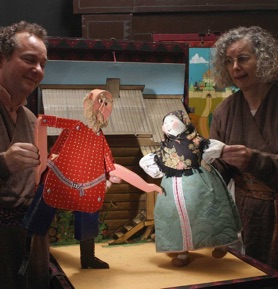 The middle section of the door has a beautiful two-part painting of a spring landscape in the style of the famous Russian illustrator Ivan Bilibin (1876-1942). As it turns out these two parts, upper and lower, are part of a series depicting all four seasons and are like a board book with flexible chain back binding. The “book” of pictures can be folded down to allow a window in the door where puppets appear, or folded up to create a space where a cutout of the boyars can be placed. Above the door is a fanlight which the Powells take literally in that they place an actual fan in that semicircular space. If the board-book centre of the door can be flipped to change the seasons, the fan in the fanlight can be moved to show whether it is day (by the sun) or night (by the moon).
The door lintels also hold secrets. They can fold out panels in two different ways to depict full-length icons in which the Powells place their heads to complete the picture. This technique of memorializing a story through art is used to end each of the stories.
The two tables are used both separately or together, notably combining with a little mane to become a horse. But each table also has secrets. We discover that the tabletop is actually like the cover of a pop-up book because when a puppeteer raises the top 90º on its hinge an elaborate pre-folded scene appears. The door and tables are so well imagined and so beautifully made that they help establish the magical atmosphere and the moral of the stories that nothing can be judged based on how it first appears.
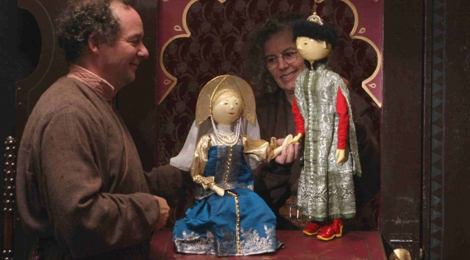
While the Powells’ play depicts an hierarchical society, their puppets portray a moral hierarchy that undercuts social distinctions. The puppets with the greatest insight and least prejudice are the most beautiful. These are the papier-mâché puppets of Tsar Peter and the peasant Fevronia. Next down the line insight are the cloth-headed puppets of the good peasant with the samovar or of Fevronia’s mother. Lower on the scale is the narrow-minded neighbour who spies on the peasant and argues about the apple tree. He is portrayed by a kind of painted wooden jumping jack where pulling the head rather than a string makes his arms and legs move up and down. Lowest on the list are the boyars who are not even portrayed separately but only as a group and only as a two-dimensional cutout.
The most “real” of the characters are not confined to a single size. Tsar Peter appears as a foot-tall doll when addressing his subjects from afar, a tabletop bunraku style puppet when in “close-up” and a life-sized paper and cloth puppet that covers the entire front of the puppeteer who carries it not to mention the life-sized icon of the character who appears at the end. Fevronia also appears in these same guises.
While the play also depicts a realm based on gender hierarchy, since women are not allowed to rule, the Powells very performance style counteracts this entirely. Both Powells interchangeably voice all the characters, meaning that both Ann Powell and David Powell will voice Peter or Fevronia depending on the 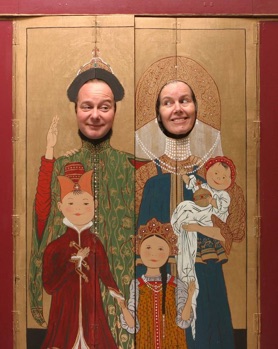 circumstances of the story. In more than one interview between Peter and Fevronia, Ann manipulates Peter while David manipulates Fevronia. This non-identification of the puppeteer with the puppet places greater emphasis on the story itself.
One of many ironies in this “puppet” show is that both Ann and David also play characters as regular actors without the use of puppets. These characters, servants at the palace, turn out to be as prejudiced as the the two-dimensional boyars. The difference is that as soon as either Powell touches a puppet, he or she becomes that character, if they so choose. Sometimes the puppeteer can have a dialogue as a servant with one of the puppets he or she is holding. From an adult perspective this all extremely metatheatrical in the most playful way possible. For children, it will simply recall the way that they enact stories themselves with puppets or other objects.
Though Tea at the Palace is much more elaborate than other Puppetmongers’ shows, that does not mean it always depends on complex means for effect. In one of the most memorable scenes David Powell waves about a white tablecloth while making storm noises simply to depict a snowstorm which momentarily engulfs people seated in the from row but later, as he lifts the cloth upwards, buries him up to the neck. The wit, imagination and sheer beauty of this show make it one of Puppetmongers’ best and a wonderful family entertainment for the holiday season.
©Christopher Hoile
Note: This review is a Stage Door exclusive.
Photos: (from top) David Powell and Ann Powell as the Royal Couple; David Powell and Ann Powell as Villagers; David Powell and Ann Powell as Icons. ©Bruce Zinger.
For tickets, visit http://puppetmongers.com.
2016-12-30


Tea at the Palace